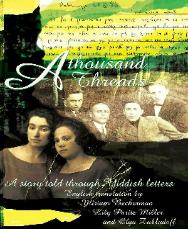
Why Invent Fiction When Life is a Storybook? A Thousand Threads by Miriam Beckerman, Lily Poritz Miller, Olga Zabludoff by Mikhail Krutikov (Oxford) Special to The Yiddish Forward No one knows how many old Yiddish letters are scattered in family archives throughout the world. Unfortunately the present-day English, Hebrew or Russian grandchildren are rarely able to understand the mamaloshen [mother tongue] of their bobehs and zaides. Anyone involved in Yiddish occasionally receives a request to translate a Yiddish letter or postcard that has turned up while cleaning a basement or an attic. Every letter adds a detail to the collective portrait of the Jewish people, and a cache of family letters sometimes contains a small chapter of Jewish history. Meanwhile, this treasure of historic sources remains uncollected, not organized or researched, and slowly fades into obscurity. We can only hope that one day a wealthy donor will be found to establish a centre for the preservation and study of the Yiddish epistolary inheritance. Such an undertaking will certainly enrich our knowledge of Jewish history. A major contribution to this utopian project is represented by the new book A Thousand Threads (Washington: Remembrance Books, 2005). This book is the achievement of three women: Miriam Beckerman, Lily Poritz Miller and Olga Zabludoff, who assembled these letters and translated them into English. The correspondence among members of their family emcompasses the years 1905 to 1960. The result is the publication of a substantial collection of letters, with a suspenseful story and vividly defined characters. The protagonist of this story is a young man by the name of Tzvi Hirsh Shapiro who leaves the Lithuanian shtetl Butrimantz with the dream of reaching New York and joining a half-brother Abraham (Itzhak), thirty years his senior, whom he has never met. It is Tzvi's misfortune to be caught in the midst of harsh anti-immigration policy, and he remains stranded in Havana for almost five years. Tzvi's only hope is Abraham, who climbed out of deprivation and poverty to become an illustrious lawyer in New York; but "that one" advises him to wait until the situation improves and meanwhile to find employment in Havana. The relationship between the brothers becomes strained, but finally Tzvi succeeds in reaching the "Goldeneh Medina." The third major figure in the book is Tzvi's sister Chaya Sarah, who remains in Butrimantz and writes news of the Old Country. In addition, there are letters from numerous other relatives in Lithuania and America. The reader's involvement grows with the developments on both sides of the Atlantic Ocean, but greater suspense arises through the inner revelations of the individual characters. Tzvi and Sarah are intelligent, sensitive young people with a keen sense of observation and an inclination towards analyzing people and events. They dream of building their lives in accordance with their yearnings, which is not easy under the conditions of the 1920s. America has no need for more Jewish immigrants from Eastern Europe, while the political and economic situation in the new Lithuanian Republic is certainly not favorable. Life, however, does not come to a halt; and every week new letters are written with all kinds of news. From Lithuania they write of business, wedding matches, studies and community events. From America they write about children and illness, send money and good advice. Tzvi, sorrowfully isolated, is at the core of a stream of letters as he struggles to adjust to the new world on the distant tropical island. The volume A Thousand Threads opens a window to a deeper knowledge of Eastern European Jewry during the period between the two world wars. Each character is unique but together they represent a certain social-psychological type: an "allrightnik," a "greenhorn," a "Yiddishe daughter." Tzvi is drawn to philosophical and psychological analysis. Abraham is inclined to preach. Despite his material success, his personal life is overshadowed with gloom. Sarah is a lively, optimistic young woman who dreams of tearing herself away from the prevailing restrictions of life in the shtetl. Their letters are more than intimate documents; they reflect the history of the times. (Review appeared in The Yiddish Forward, page 16, Friday, July 8, 2005. Translated by Miriam Beckerman, July 14, 2005) |
|||||||||||||||
![]() |
|||||||||||||||
| "... a living picture of the suffering and experiences of the Jewish immigrants of Eastern Europe on the way to their new homes across the ocean..." - Simcha Simchovitch Canadian Jewish News September 8, 2005 |
|||||||||||||||
| "The style and content of the writing reveal a tenacious attitude typical of the immigrant in the early 20th century, as well as an elegant manner of speaking. ...beautifully written... valuable from a historical and social perspective." The Jewish Tribune August 25, 2005 |
|||||||||||||||
| "More than any other book that your editor has ever read, this one brings home the trials and tribulations of immigration. It shows the dialogue that crossed the Atlantic as families communicate in writing. Very highly recommended." Philip "Fishl" Kutner Editor, Der Bay January 2006 |
|||||||||||||||
| "This book shines in the details. Tzvi writes about fellow immigrants, his hopes and dreams, the iron cots he buys to sleep on, the food he misses. The people come alive in the words. Thanks to this book I have a better understanding of what my Zaida went through, and a better understanding of who he was because of it." The Jewish Magazine Winter 2006 |
|||||||||||||||
| "...demonstrates the trials and tribulations of being torn from one's home and homeland in an attempt to make a new life. It is a story of joy and tribulation, a story of loss as the result of the Holocaust. It is a story of Jewish life." Lifestyles Magazine International edition Winter 2005 |
|||||||||||||||
| HOME PAGE | |||||||||||||||